 Coupe-file disponible
 Que voir à l'intérieur du Palácio de Queluz
Un parcours privilégié pièce par pièce à travers la Salle du Trône, la Salle des Ambassadeurs, la chambre Don Quichotte et les jardins à la française du Palácio Nacional de Queluz.
Le Palácio de Queluz réunit une vingtaine de salons d'apparat disposés en circuit quasi linéaire sur un seul niveau principal, complétés par les jardins à la française qui enveloppent les flancs est et sud de l'édifice. Contrairement aux vastes palais royaux européens où l'on perd aisément le fil de sa visite, Queluz offre une échelle intime qui permet d'en parcourir l'ensemble à rythme soutenu en quarante-cinq minutes environ, puis de revenir sur les espaces qui méritent une attention prolongée. Ce guide vous accompagne à travers l'intérieur selon le parcours habituel des visiteurs — la Salle du Trône et la Salle des Ambassadeurs comme fleurons du rococo, le Salon de Musique avec ses instruments d'époque du XVIIIe siècle, la petite mais historiquement chargée chambre Don Quichotte où le roi Pierre IV naquit en 1798 et mourut en 1834, et le long Corredor das Mangas, galerie ornée d'azulejos — avant de rejoindre les jardins Robillion.
La Salle du Trône (Sala do Trono)
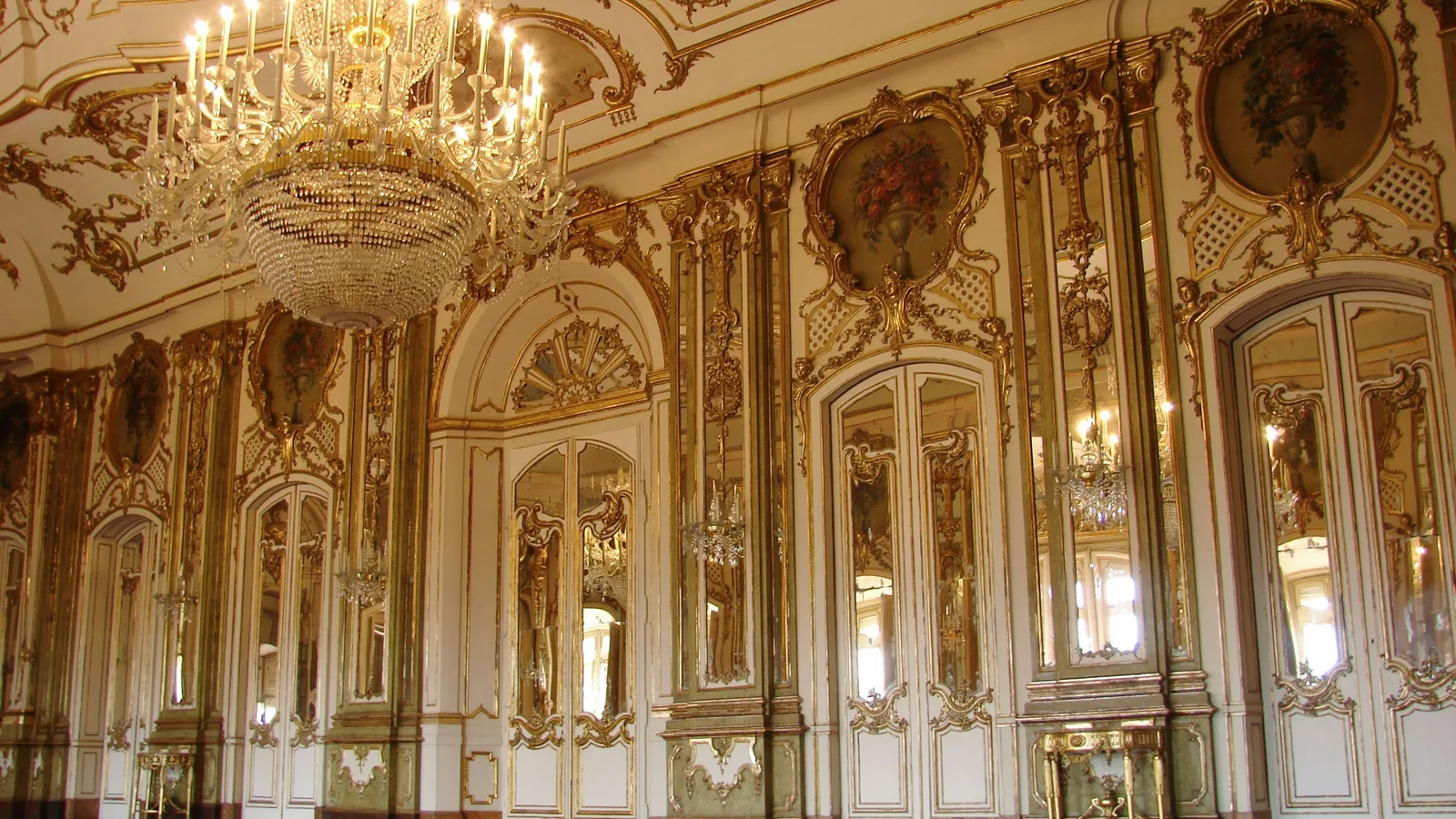
La Salle du Trône constitue le joyau photographique du palais et l'espace que la plupart des visiteurs retiennent. Il s'agit d'une longue galerie rococo en blanc et or, aux murs tapissés de miroirs reflétant des lustres en cristal taillé et un plafond peint célébrant la dynastie de Bragance. Les sculptures dorées sont l'œuvre de l'architecte français Jean-Baptiste Robillion, qui prit en charge les principaux intérieurs à partir des années 1750, et la salle accueillit réceptions d'État, audiences royales et grands bals durant l'apogée de la monarchie portugaise tardive. Les fenêtres orientées à l'est laissent entrer une lumière matinale douce qui sublime la dorure — entre neuf heures trente et onze heures environ, la salle se révèle sous son meilleur jour photographique.
Levez le regard plutôt que de ne fixer que l'horizon. Le plafond peint — une allégorie célébrant la maison royale de Bragance — demeure l'élément le plus sous-estimé de la salle, souvent négligé par les visiteurs concentrés sur les miroirs et lustres à hauteur d'œil. Regardez également vers le bas : le motif du parquet rayonne depuis un axe central aligné avec le long canal des jardins visible à travers les fenêtres orientales, un lien visuel délibéré entre l'intérieur et le paysage ordonnancé extérieur. La Salle du Trône est un espace que la cour de Bragance concevait comme le centre symbolique d'une cour de plaisance plutôt que de gouvernement ; sa splendeur s'apparente à celle d'un pavillon de festival musical, non à celle d'une chambre parlementaire.
La Salle des Ambassadeurs (Sala dos Embaixadores)
La Salle des Ambassadeurs servait de salon de réception principal pour les dignitaires étrangers en visite durant la monarchie portugaise tardive. Elle se révèle architecturalement plus mesurée que la Salle du Trône — plus haute, dotée d'un plafond à caissons soutenu par des pilastres jumelés en tonalités pastel, et d'un lustre central qui ancre la symétrie. Les murs accueillent des portraits de monarques de Bragance et de leurs alliances royales européennes, et le motif du sol reprend la logique axiale de la Salle du Trône sans toutefois la dupliquer.
Deux histoires se superposent dans cette salle. D'abord, l'incendie de 1934 qui ravagea l'aile sud endommagea considérablement la Salle, et la restauration menée par l'architecte Raul Lino dans les années 1930 et 1940 reste discrètement visible à quiconque observe attentivement les joints de stuc — la salle que vous découvrez aujourd'hui se compose à 80 pour cent environ de matériaux d'origine du XVIIIe siècle et à 20 pour cent de restauration soignée des années 1930. Ensuite, en hiver ou par temps humide, lorsque l'École Portugaise d'Art Équestre ne peut se produire en extérieur au Picadeiro Henrique Calado, les représentations de l'école se déplacent dans cette salle. Assister à un spectacle de dressage classique sur étalons lusitaniens dans une salle de réception ambassadoriale des Bragance compte parmi les expériences les plus saisissantes qu'offre un palais européen — confirmez le calendrier hivernal auprès de Parques de Sintra en amont si vous souhaitez organiser votre visite en conséquence.
Le Salon de Musique et la chambre Don Quichotte
Le Salon de Musique occupe le côté occidental de l'axe intérieur principal et abrite une collection d'instruments d'origine du XVIIIe siècle — clavecins, pianofortes, violes — utilisés par la cour de Bragance pour concerts de chambre et danses. Le plafond peint fut détruit lors de l'incendie de 1934 puis reconstitué lors de la restauration post-incendie, mais le parquet d'origine, les lambris muraux et les instruments eux-mêmes demeurent largement intacts. La salle se révèle sous son meilleur jour en début d'après-midi, lorsque la lumière occidentale pénètre par les hautes fenêtres donnant sur les jardins.
Juste à côté se trouve la petite salle Don Quixote (Sala D. Quixote) — l'espace le plus chargé d'histoire de tout le palais. Cette chambre à coucher voûtée, dont la coupole est ornée de scènes du Don Quichotte de Cervantès, est le lieu où le roi Pierre IV naquit en 1798 et mourut en 1834. Pierre IV régna comme empereur Pierre Ier du Brésil avant d'abdiquer le trône brésilien pour revendiquer la couronne portugaise — le lien entre les histoires royales des deux pays se concentre dans cette unique chambre. La pièce est petite et peut facilement passer inaperçue si vous circulez rapidement ; prenez le temps de vous arrêter ici, levez les yeux vers les scènes de Cervantès, et considérez cette salle comme l'espace biographique le plus dense de tous les palais Bragance.
Le Corredor das Mangas et les salles secondaires
Le Corredor das Mangas est une longue galerie carrelée longeant le côté jardin du palais, tapissée du sol au plafond de panneaux d'azulejos bleus et blancs peints à la main représentant des scènes de chasse, de pêche et de pastorale. Le corridor a échappé aux dommages majeurs de l'incendie de 1934 et subsiste en grande partie tel qu'il était sous la reine Marie Ire dans les années 1780. Le parcourir lentement constitue l'une des expériences les plus apaisantes du palais — la lumière naturelle venant du côté jardin illumine les carreaux, et l'iconographie des azulejos récompense une lecture attentive pour les visiteurs intéressés par la culture visuelle portugaise du XVIIIe siècle.
Les appartements royaux — la chambre du roi, la chambre de la reine, le boudoir, les cabinets de toilette — sont préservés tels que la famille les utilisait, avec mobilier, porcelaines et effets personnels en place. Le Lantern Hall, l'escalier Robillion avec ses murs carrelés de bleu, et la petite chapelle méritent quelques minutes chacun. Les visiteurs qui tentent de visiter Queluz en quarante-cinq minutes manquent systématiquement ces espaces secondaires, ce qui est une erreur — Queluz est un palais qui récompense une circulation lente à travers les salles secondaires autant que le temps passé dans les pièces d'apparat comme la salle du Trône. Prévoyez environ quatre-vingt-dix minutes pour l'intérieur complet si vous souhaitez tout voir convenablement.
Les jardins à la française et le canal d'azulejos
En sortant du palais sur la terrasse orientale, les jardins à la française se déploient selon deux axes principaux. Les parterres immédiatement en contrebas du palais sont organisés en compositions géométriques de buis taillés en carrés, losanges et formes figuratives, avec des statues mythologiques en plomb coulées dans l'atelier du sculpteur britannique John Cheere — Triton, Neptune, Bacchus, les saisons — disposées le long des allées centrales. Les figures en plomb sont à hauteur de main plutôt que monumentales, ce qui explique en partie pourquoi le jardin de Queluz dégage une atmosphère intime plutôt qu'impériale.
Le long canal d'azulejos axial longe la limite orientale du jardin à la française, étroit et bordé de panneaux d'azulejos peints à la main sur ses parois intérieures. La cour organisait autrefois des fêtes nautiques le long de ce canal — une petite flottille de barques décoratives naviguant d'un bout à l'autre tandis que des musiciens jouaient depuis des pavillons temporaires. Aujourd'hui, l'eau demeure, les azulejos subsistent sur de nombreuses sections, et la promenade le long du canal constitue l'une des expériences les plus paisibles de tout l'ensemble de Sintra. La lumière de fin d'après-midi effleure les parterres depuis l'ouest et offre les conditions de jardin les plus chaleureuses. Comptez trente à quarante-cinq minutes pour les jardins à rythme tranquille, davantage si vous souhaitez prendre le temps d'identifier les statues de plomb individuelles et de déchiffrer les azulejos du canal.
Questions fréquentes
Combien de temps prévoir à l'intérieur du Palais de Queluz ?
Quarante-cinq minutes constituent le minimum express pour les principaux salons d'apparat. Quatre-vingt-dix minutes offrent un rythme confortable pour l'intérieur complet incluant les salles secondaires. Ajoutez trente à quarante-cinq minutes supplémentaires pour les jardins à la française. Prévoyez environ deux heures au total sur place.
Quelle est la salle la plus importante ?
La Salle du Trône est la pièce maîtresse photographique, celle dont les visiteurs se souviennent le plus. La petite chambre Don Quichotte est la plus chargée d'histoire : le roi Pierre IV y est né en 1798 et y est décédé en 1834. Ne manquez ni l'une ni l'autre.
Les instruments d'époque du XVIIIe siècle de la Salle de Musique sont-ils encore jouables ?
Ils sont conservés comme pièces de musée et non comme instruments de concert, et ne sont pas joués pour les visiteurs. Des concerts baroques occasionnels au palais utilisent des instruments d'époque appropriés — consultez le programme de Parques de Sintra pour connaître les dates des concerts actuels.
Pourquoi la chambre Don Quichotte porte-t-elle ce nom ?
Le plafond en coupole est orné de scènes tirées du Don Quichotte de Cervantes, d'où le nom de la pièce. Ce thème littéraire était en vogue à la cour des Bragance à la fin du XVIIIe siècle. La naissance et le décès du roi Pierre IV dans cette même chambre renforcent encore son poids historique.
Qu'est-ce qui a survécu à l'incendie de 1934 ?
La Salle du Trône, la chambre Don Quichotte, la galerie de faïences du Corredor das Mangas et environ 80 % des salons d'apparat principaux ont été préservés. Le plafond de la Salle de Musique et des parties de la Salle des Ambassadeurs ont été perdus, puis restaurés avec sobriété sous la direction de l'architecte Raul Lino dans les années 1930 et 1940.
Les jardins sont-ils accessibles ?
Dans l'ensemble, oui — les allées de gravier sont plates et praticables en fauteuil roulant le long des axes principaux du parterre et de la promenade du canal. Quelques courtes marches apparaissent près des terrasses du canal. Les jardins sont nettement plus accessibles que ceux du Palácio da Pena sur la montagne de Sintra.
Puis-je photographier à l'intérieur du palais ?
La photographie personnelle sans flash est autorisée dans l'ensemble du palais et des jardins. Les trépieds, monopodes, éclairages professionnels, matériel vidéo commercial et perches à selfie sont interdits dans les salles — veuillez consulter la signalétique à l'entrée le jour de votre visite. Les drones ne sont pas autorisés au-dessus du domaine.
Un audioguide est-il disponible ?
Des audioguides et visites thématiques sont proposés par l'exploitant moyennant supplément. Notre offre privilège comprend également un briefing audio de cinq minutes sur l'histoire du palais, la chambre Don Quichotte et les jardins Robillion, téléchargeable avant votre voyage.
Des visites guidées sont-elles proposées ?
Parques de Sintra propose des visites guidées thématiques du palais moyennant supplément à certaines dates — consultez le programme en vigueur pour connaître les disponibilités et les thématiques. Le billet standard comprend l'accès libre au parcours complet des salons d'apparat et des jardins.
Quel est l'élément le plus sous-estimé ?
La galerie d'azulejos du Corredor das Mangas. Les visiteurs pressés la traversent souvent sans s'arrêter, mais les panneaux d'azulejos du XVIIIe siècle du sol au plafond, représentant des scènes de chasse et pastorales, comptent parmi les plus beaux décors de faïence conservés dans un palais royal portugais. Parcourez-la lentement en profitant de la lumière des jardins qui pénètre latéralement.